
Have you ever listened to an English conversation, understood the general meaning, but struggled to catch every word? This is a common challenge for English learners, even those with a strong vocabulary and a good understanding of grammar. The problem is often not what you know, but how quickly you can recognize spoken words.
One effective way to overcome this challenge is through English dictation practice. By listening carefully and writing down what you hear, you can develop stronger listening comprehension, recognize different pronunciation patterns, and become more confident when communicating in English.
MicroEnglish makes this process easier with interactive dictation exercises, audio recordings, and immediate feedback. Instead of simply listening and hoping to improve, you can actively test your understanding, identify mistakes, and work on the sounds and words you find difficult.

MicroEnglish is an online English learning platform that offers short, practical lessons designed to help learners develop their language skills.
One of its useful learning tools is its collection of English dictation exercises with audio and feedback. These exercises encourage learners to listen carefully, write what they hear, and check their answers.
The process is straightforward, making it suitable for independent study and regular listening practice.
Rather than overwhelming learners with long recordings, MicroEnglish uses short audio activities that allow them to concentrate on specific words, expressions, and pronunciation patterns.
Learners can explore the platform’s English dictation practice exercises and try a free sample without creating an account.
Listen to Real English Audio and Type What You Hear
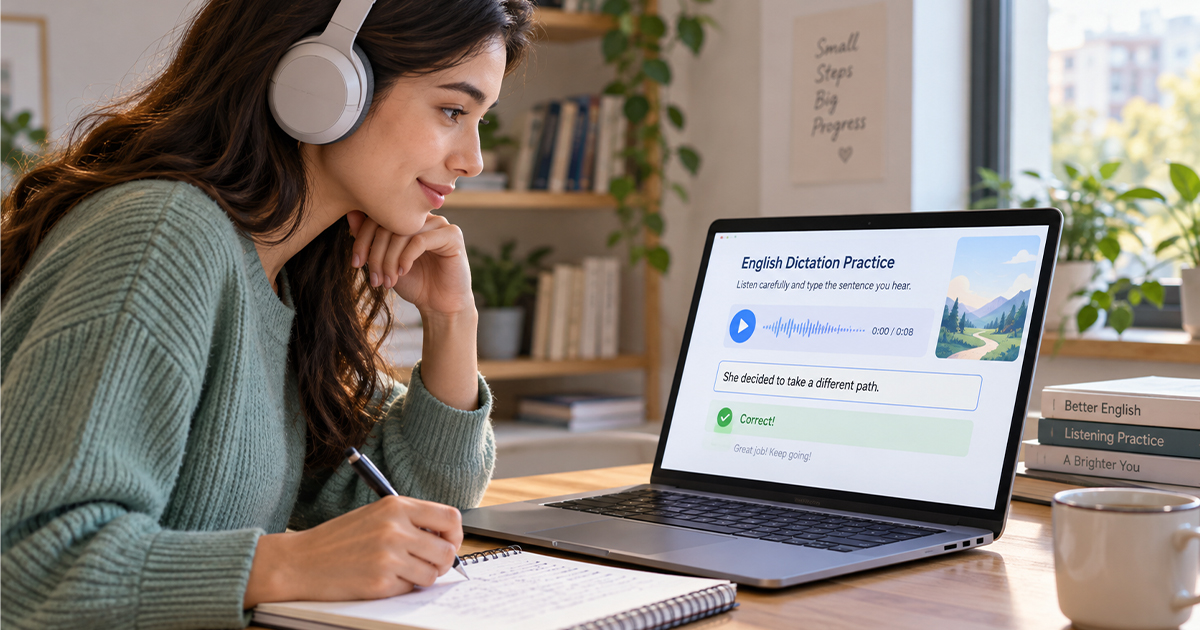
The first step in a MicroEnglish dictation exercise is listening to a short English audio recording.
After playing the recording, you type the words you hear into the provided answer field.
This simple activity requires active concentration. Instead of reading subtitles or guessing the meaning from context, you must pay attention to pronunciation, word boundaries, and sentence structure.
MicroEnglish also provides different answer entry options, including typing individual words into separate spaces or entering the complete sentence.
For example, imagine hearing the sentence:
“I usually take the train to work.”
Although the sentence looks simple, a learner might miss the word “the” or confuse the pronunciation of “train” with another word.
Typing the sentence helps reveal these small listening difficulties.
With repeated practice, learners can become more comfortable identifying words in connected speech and understanding complete sentences.
Get Instant Feedback and Learn from Your Mistakes
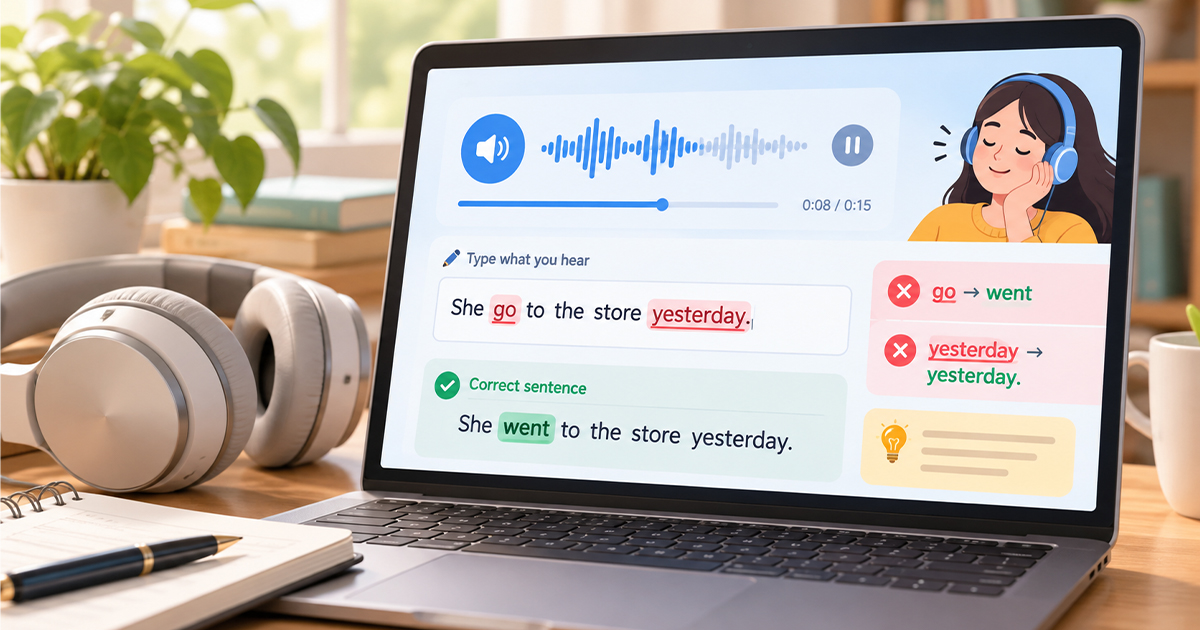
One of the biggest advantages of interactive dictation practice is the ability to receive feedback immediately.
When practicing independently with a podcast or video, learners often have no reliable way to check whether they understood every word correctly.
MicroEnglish addresses this challenge by allowing users to submit their written answers and compare them with the correct transcription.
The feedback helps learners identify words they missed, misunderstood, or spelled incorrectly.
For instance, you might hear “He has finished his work” but type “He finished his work.”
Although the meaning is similar, the missing word changes the grammatical structure of the sentence.
By reviewing this difference, you can become more attentive to auxiliary verbs and other small grammatical details during future listening exercises.
MicroEnglish also offers hints and transcript options, allowing learners to review difficult sections and understand their mistakes.
This creates a useful learning cycle: listen, write, check, correct, and listen again.
Replay Audio and Adjust Playback Speed
Understanding spoken English can become difficult when speakers use unfamiliar vocabulary, connected speech, or rapid pronunciation.
MicroEnglish allows learners to replay recordings and adjust playback speed, making challenging exercises more manageable.
For example, you can listen at the normal 1x speed or reduce playback to 0.75x when you need extra time to recognize individual words.
Slower playback can be particularly useful when practicing unfamiliar accents or listening to expressions in which several words sound connected.
A practical approach is to listen to the recording at normal speed first. If you miss something, replay the audio at a slower speed and focus on the difficult section.
Once you recognize the words, return to normal speed and listen again.
This method can help bridge the gap between understanding carefully spoken English and recognizing more natural speech patterns.
MicroEnglish combines several features that make its dictation activities practical for learners with different listening abilities.
From accent selection to level based exercises and detailed feedback, the platform provides tools that support structured and independent English listening practice.
Practice American, British, and Australian Accents
English pronunciation varies considerably across different regions.
A word spoken by an American English speaker may sound different when pronounced by someone using British or Australian English.
These variations can involve vowel sounds, consonant pronunciation, rhythm, and intonation.
For learners who only practice one accent, understanding speakers from other English speaking regions can be challenging.
MicroEnglish helps address this issue by offering recordings with American, British, and Australian accents.
Learners can select the available accent options and compare how familiar words and expressions sound in different varieties of English.
For example, the word “water” may sound noticeably different depending on the speaker’s accent.
Practicing with multiple accents can help learners develop greater listening flexibility, which is useful when watching international videos, traveling, studying abroad, or communicating with people from different countries.
Instead of becoming comfortable with only one pronunciation style, learners gain exposure to a broader range of spoken English.
An effective listening exercise should be challenging enough to encourage improvement without becoming so difficult that it causes frustration.
MicroEnglish organizes its dictation lessons according to CEFR proficiency levels, from A1 to C2.
This allows learners to choose activities that match their current abilities and gradually progress toward more challenging listening material.
The available levels include:
The platform also allows users to explore lessons by topic, including everyday English, grammar, idioms, and phrasal verbs.
This flexibility helps learners choose material that matches both their interests and language proficiency.
For the best results, start with exercises where you understand most of the sentence but occasionally miss individual words. As your accuracy improves, gradually move to more challenging recordings.
Improve Listening Accuracy with Word-by-Word Feedback
One of the most useful features of MicroEnglish is its word-by-word answer checking.
Traditional listening exercises often focus on whether the learner understands the overall meaning of a recording.
However, understanding the main idea does not always mean recognizing every word correctly.
MicroEnglish provides more detailed feedback by highlighting the differences between the learner’s answer and the expected transcription.
This makes it easier to identify specific listening problems.
For example, learners may discover that they consistently struggle with:
Recognizing these patterns is important because repeated mistakes can reveal areas that need targeted practice.
Instead of repeating an entire lesson without knowing what went wrong, learners can concentrate on the exact words and sounds they missed.
MicroEnglish also provides additional learning support for signed in users, including the ability to save checked answers and receive guidance about recurring mistakes.
Over time, reviewing these errors can help learners build better listening habits and improve their ability to recognize spoken English accurately.
English listening skills improve through focused practice, careful attention, and consistent feedback. MicroEnglish brings these elements together in a convenient learning experience.
Whether you are beginning your English learning journey or working toward more advanced listening comprehension, short dictation exercises can become a valuable part of your daily routine.
Visit MicroEnglish, select a suitable lesson, and discover how much you can learn from listening closely to just a few sentences.
Frequently Asked Questions
What is English dictation practice?
English dictation practice is a listening activity in which you hear an audio recording and write or type the exact words spoken. It helps improve listening comprehension, spelling, vocabulary recognition, and awareness of natural pronunciation patterns.
Is MicroEnglish suitable for beginners?
Yes. MicroEnglish offers dictation exercises organized by CEFR proficiency levels, including A1 and A2 activities for beginners and elementary learners. More experienced learners can explore intermediate and advanced exercises.
Can I practice English dictation for free on MicroEnglish?
Yes. MicroEnglish allows visitors to try free dictation samples without creating an account. The platform offers three free sentences in each lesson, while access to additional activities may depend on the lesson and membership.
Does MicroEnglish provide feedback on dictation mistakes?
Yes. After typing an answer, learners can check their work and receive word-by-word feedback. This helps them identify missing or incorrect words and compare their responses with the expected transcription.